
Visual Literacy Walloped
words by Sean Rayford
Hours after the Washington Post laid off 300 journalists including their entire staff of photojournalists, I came across a social media post from Philippines-based photojournalist Jes Azner.
“WHY ARE PHOTO DEPARTMENTS ALWAYS AMONG THE FIRST TO BE AXED” was the headline.
The first thing Jes addressed was “visually illiterate management,” These folks look at photojournalism as an aesthetic element. Not a layer of the storytelling cake, but rather, the sprinkles on top of the icing. or these folks.
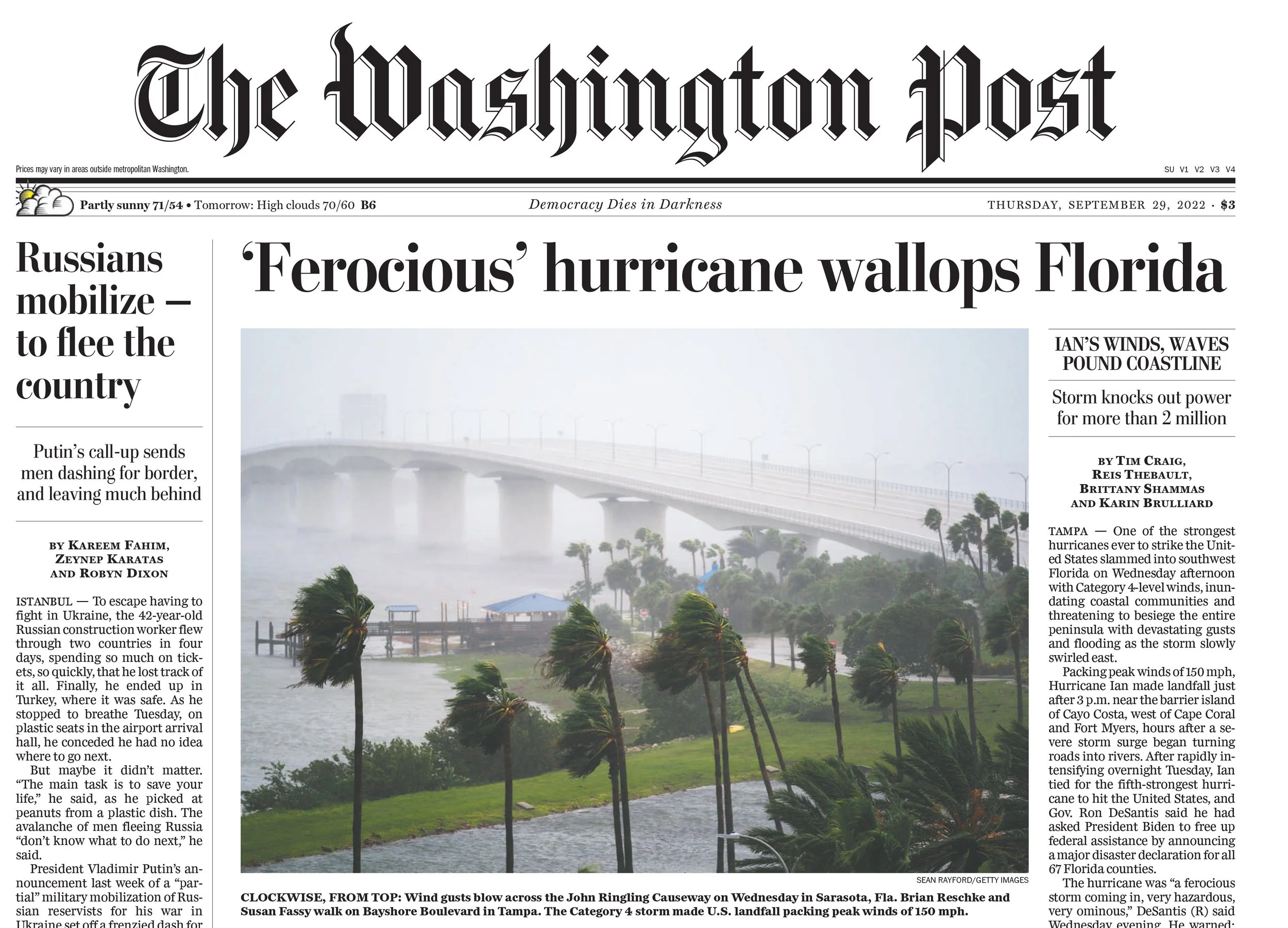
Hurricane Ian makes landfall in Florida.
For these folks, photojournalism is decoration.
I’d argue that the visual illiteracy often extends through much of the newsroom — which has historically excluded photojournalists from much of the process. In the print age, the reporter centered hierarchy had them competing for space with photojournalists.
From 2000–2012, during the first wave of mass newspaper cuts, photojournalists were hardest hit in U.S. newsrooms, with 43% of them losing employment, compared to 32% of reporters.
From 2003-2020, the primary local daily newspaper in Columbia, SC cut its photo department from 13 to two staffers.
As we continue in a world dominated by visual communication, decision-makers at newspapers continue their quest against visual literacy. Imagine a news entity, where journalists could identify visually compelling stories at a time in history when visual storytelling has never been more important.
On YouTube, three things determine the success of a video: topic, title and thumbnail.
The thumbnail is the best way to get the attention of the viewer. This is the power of the still image. Nothing else can stop the scroll like this. What happens when your newspaper visuals are no better than most of what is on social media? What do psychologists say about first impressions?
Visual literacy is something I’ve addressed specifically with folks in my local news media. Newsrooms are sabotaging their ability to work with professional photojournalists. Because no one at the newsroom knows what to do with the photos or how to communicate with a photojournalist.
They don’t understand that the power of still photography is in its ability to tell a story in a single frame, and so they publish giant galleries of snapshots. Reporters who don’t regularly work with photojournalists can’t stop themselves from getting in the photographer’s shot.
As a photojournalist, I don’t take assignments to get wealthy. I take assignments for survival and the opportunity to work on stories I can be proud of. But when a newsroom is visually illiterate, it’s rare to get that opportunity as a photojournalist.
In newsrooms without photojournalists, the visual journalism snowballs downhill. We see cell phone photos shot from the driver’s seat as someone passes by a scene. Zero effort level and a bad first impression for readers.
At these entities freelance photojournalists get sent to assignments that are visually boring, and don’t have the most basic information they need in order to contribute as a storyteller. Everything in the process is gummed up and the end product doesn’t serve the community. Resources wasted and trust lost.
What are readers supposed to think about an entity where quality and implementation of visual storytelling is no better than what their neighbor is posting on social media? What are readers suppose to think when newspapers disregard their first and biggest chance to demonstrate quality and professionalism?
And as a result, the journalists and the news entity start with a major handicap in the age of visual storytelling.
What are readers supposed to think about the quality and investment in journalism when random neighbors and business owners replace professional photojournalists? Do these citizen journalists use Photoshop or generative AI? Do they have local business or political motivations?
If you think photojournalism should have ethical guardrails, who is monitoring that?
There are many challenges facing the modern newsroom. But if you want to sabotage a news media organization, a fast route ignores visual storytelling professionals during the age of visual storytelling.